Should you write your story in past or present tense?
“Books let you know what tense they want to be written in.” – David Mitchell
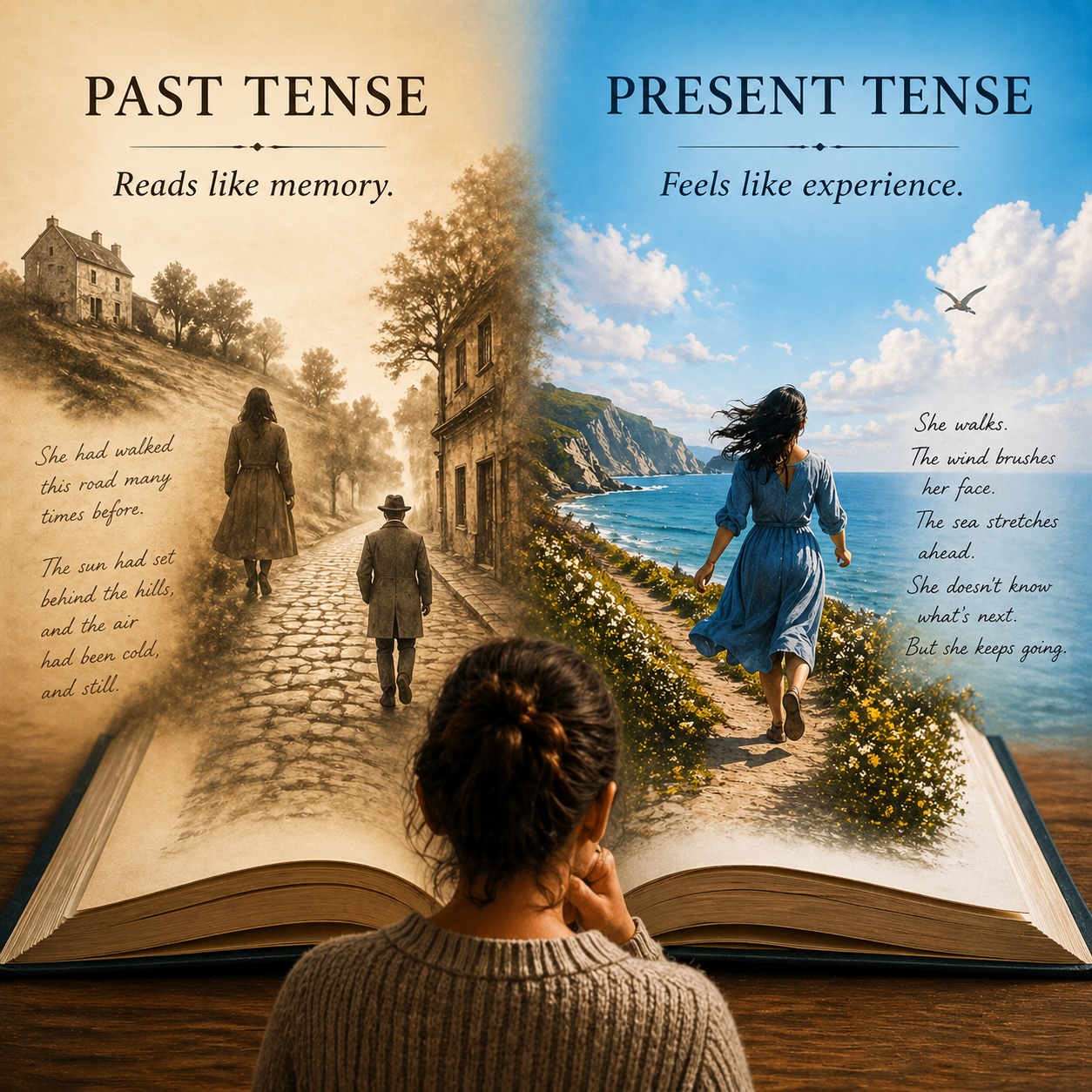
One of the first decisions a writer makes is whether to tell their story in the past or present tense. Do you write “She strides into the room” or “She strode into the room?” There is no right or wrong choice—only different effects. The choice isn’t grammatical, it’s stylistic, and it shapes how the reader experiences the story.
Past Tense
Past tense tells the story as something that’s already happened:
Maria picked up the letter, and her stomach dropped. She already knew what it would say.
This is the dominant tense in both literary and commercial fiction, from Pride and Prejudice to Harry Potter. It mirrors how we recount real-life experiences: “Something weird happened today,” or “Maria told me a secret last week.” This tense becomes imprinted on us from childhood with every story that began, ‘Once upon a time, there was…’
Because of its familiarity, the past tense often feels invisible to the reader, making it a safe bet for writers. Its deeper strength is narrative flexibility. A past-tense narrator has already lived through events and can move freely through time. They can reflect on what’s happened and hint at what’s coming:
He hesitated a moment. It looked as though he might say something, but then he turned away. Little did she know this would be the last time she saw him.
Here, the narrator has the benefit of hindsight—a perspective that creates dramatic irony. The tension comes from the reader watching a character walk toward a future they cannot see, making the moment feel tragic and inevitable.
Present Tense
Present tense puts the reader inside events as they happen rather than after the fact:
Maria opens the door and freezes. Scent lingers in the air—not hers, his.
Some writers choose present tense because they believe it creates immediacy. I think that’s a misconception. Tense doesn’t give the prose its pulse—craft does. Writers who make you forget to breathe mid-sentence are rarely doing it because of tense. They’re doing it with rhythm, compression, and precision. All of that is available in past tense, too.
What present tense does is shift the perspective. Because the narrator is not recalling events with hindsight, the character’s uncertainty becomes the reader’s uncertainty too:
He hesitates a moment. It looks like he might say something, but then he turns away. She wonders if she will ever see him again.
Compared to the past-tense version, this creates suspense rather than irony. Neither the character nor the reader knows what’s coming next, and that shared not-knowing is the present tense’s greatest strength.
Different, Not Better
Each tense has its advocates. David Mitchell argues that “…some books just come alive in the present tense in a way I feel they don’t when told in the past tense.” Philip Pullman counters: “What I dislike about the present-tense narrative is its limited range of expressiveness. I feel claustrophobic, always pressed up against the immediate.” What feels like a limitation to one writer is an asset to another. The question is never which tense is superior, but which one best serves your story.
Certain genres tend to work more naturally with one tense than the other. Broadly speaking, the past tense suits historical fiction, epic fantasy, mystery novels, and multi-generational sagas—stories that need scope, movement across time, and the weight of retrospection. For example, The Lord of the Rings and Game of Thrones suit past tense because the stories feel like history being told. In genres like young adult fiction, psychological thrillers, romance, and survival stories, such as The Hunger Games, present tense is frequently effective, especially when tension, uncertainty, and high stakes matter most. That said, Hilary Mantel wrote her historical novel Wolf Hall in the present tense, and it won the Booker Prize. So much for genre rules.
Let the Story Decide
Ultimately, the choice isn’t about which tense is correct. It’s about which one better supports the story you’re writing. I learned this lesson the hard way. I drafted my novel Graëlfire in the present tense, convinced it suited a modern-day Grail quest adventure unfolding over a few weeks. Present tense gave the story mystery and kept the reader guessing. By the end of the first draft, though, I realised the novel’s emotional weight rested as much on the medieval backstory as on the present-day plot. The conflicts my characters faced had their roots centuries earlier, and it became too clunky and distant to reveal all that through exposition. The past needed to speak for itself.
So, I introduced a historical thread, and the book became a dual timeline narrative with alternating threads. That solved one problem and created another. Present tense pulls everything into the here and now, flattening the relationship between cause and consequence. My medieval sections also needed the depth and resonance of history, not the pulse of something unfolding alongside the modern plot. But switching tenses between timelines would have been jarring for the reader, so I rewrote both threads in the past tense. It meant considerable redrafting, but it gave the novel far more balance and cohesion.
My forthcoming book is different. I drafted it first as a film script—a discipline that forced me to tell the story through dialogue alone, leaving little room for explanation and the world-building I tend to linger in. When I converted it into prose, the present tense carried over naturally—and it proved the right call. The atmosphere is gothic, the timeframe tight, and the protagonist under sustained psychological pressure. Present tense heightens all of that. Unlike Graëlfire and its sequel Graëlstorm, where retrospection bore the weight of consequence, this book needs the beat of doubt and uncertainty.
Choosing between past and present tense is a stylistic decision: it’s about whether your story benefits more from the clarity of hindsight or the uncertainty of unfolding experience.